


Motley Fool Recommends 10 Stocks: The Math Logic Behind a 70% Win Rate and Four Real Risks
2026年7月11日
AI Didn’t Take Your Job — Yet: The Three-Party Delay Behind America’s Corporate Hiring Revival
2026年7月28日Meta’s Shift: Why the AI Arms Race is Now a Landlord’s Game
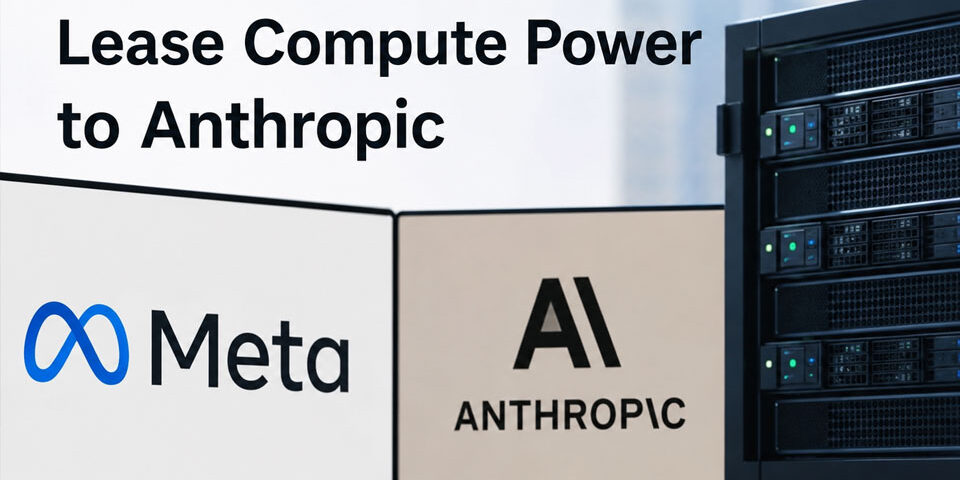
The reported discussions between Meta Platforms Inc. and AI startup Anthropic regarding a potential $10 billion cloud computing deal mark a pivotal evolution in the generative AI landscape. While market
participants may reflexively interpret this as a sign of weakness in Meta’s proprietary Llama models, a closer examination of the capital-intensive nature of Large Language Model (LLM) training suggests a
more sophisticated strategic maneuver: the transition from pure-play AI research to institutional-grade infrastructure monetization.
The CAPEX Paradox: Monetizing the “AI Utility”
Meta’s projected 2026 capital expenditures, ranging between $125 billion and $145 billion, have cast a shadow of investor skepticism over the company’s long-term profitability. By positioning its data centers
as a service provider for Anthropic, Meta is effectively treating its massive AI investment not as a cost center, but as a utility-grade asset.
The economic logic is sound. Scaling frontier models requires a constant, high-utilization rate of H100s and next-generation GPUs. By leasing spare capacity, Meta captures high-margin revenue from its peerwhile maintaining its own research autonomy. This move challenges the dominance of Amazon Web Services (AWS), Microsoft Azure, and Google Cloud, potentially carving out a new tier in the “Cloud-AI”
hierarchy.
The Great Divergence: Infrastructure vs. Algorithm
The AI sector is undergoing a profound structural bifurcation. We are no longer observing a general “model-building” race, but a split between two distinct castes:
Infrastructure Barons: Firms like Meta, Microsoft, and Alphabet that own the physical footprint,energy capacity, and silicon pipelines required to train models at scale.
Algorithm Labs: Highly specialized entities like Anthropic and OpenAI that focus on architectural breakthroughs but rely on external infrastructure “barons” to scale their training runs.
This division creates a fragile dependency. Anthropic’s search for compute outside of its traditional partners—Amazon and Google—highlights the scarcity of top-tier, low-latency compute. Meta is moving
to occupy this void, effectively becoming the “neutral broker” of the AI age.
A Strategic Hedge Against Uncertainty
Is Meta’s Llama falling behind? On the contrary, the open-source nature of Llama has already disrupted the market, forcing competitors to lower their API prices. By leasing infrastructure to Anthropic, Meta
gains deep insight into how other state-of-the-art models operate, allowing the company to iterate its own architecture and chip development (MTIA) based on the usage patterns of the industry’s most demanding
users.
Q&A: Understanding the Meta-Anthropic Dynamics
Q: Does leasing compute to Anthropic prove that Meta’s Llama model is inferior?
A: No. It indicates a pivot to multi-stream revenue. Meta leverages Llama to command the open-
source developer ecosystem while utilizing its infrastructure to extract rent from the proprietary
model labs.
Q: Is this the end of the “AI Model Race”?
A: It is the end of the “do-it-yourself” era. The cost of training frontier models has reached a barrier
to entry that only hyperscalers can clear. Future innovation will be dominated by collaborative
clusters rather than isolated silos.
Q: How does this impact the Cloud giants (AWS/Azure)?
A: It introduces a major disruptor. Meta’s entry into the high-end compute rental market could exert
pricing pressure on traditional cloud