


AI Didn’t Take Your Job — Yet: The Three-Party Delay Behind America’s Corporate Hiring Revival
2026年7月28日Formaldehyde Cabbage: China’s Regulatory Blind Spot, Trust Crisis, and the Cost to Farmers
Disclaimer: This article is for informational purposes only and does not constitute investment advice. Financial markets involve significant uncertainty. Please consult a qualified professional before making investment decisions.
Summary: A blogger’s video exposing formaldehyde-treated cabbage in Hebei’s Kangbao County triggered a national food safety crisis in China. Three central ministries issued emergency directives; multiple cities imposed bans and inspections. The incident exposes a structural enforcement blind spot in China’s segmented regulatory model — neither farm-level nor market-level oversight covers the wholesale purchasing and transit phase where violations occur. With administrative penalties far too low to deter the economic incentive, and similar incidents having recurred in 2012 and 2015, the pattern points to systemic failure rather than isolated misconduct. Compounded by economic headwinds weakening consumer confidence, this is a governance stress test with real social stability implications.
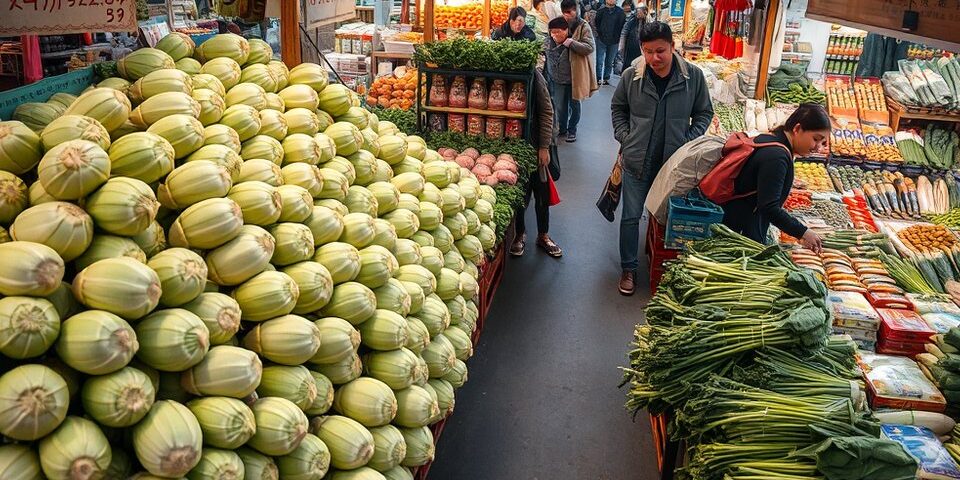
On August 22, 2026, blogger “Yulie Qige” posted a video exposing cabbage wholesalers in Kangbao County, Zhangjiakou City, Hebei Province using formaldehyde solution to preserve freshness. The video rapidly ignited public outrage. Local authorities confirmed the incident and took compulsory measures. On August 23, the State Council Food Safety Commission Office, the Ministry of Agriculture and Rural Affairs, and the State Administration for Market Regulation jointly ordered a full traceability investigation, strict prevention of problematic products reaching the market, and severe punishment for violations. This is yet another systemic food safety crisis ignited by social media and enabled by regulatory gaps.
The core issue is not a few bags of tainted cabbage but that the incident once again illuminates a structural blind spot that has persisted in China’s food safety system for over a decade, compounded by the social destabilization risk of a food safety crisis layered on top of economic headwinds.
Regulatory Vacuum: The Unpoliced Gap Between Farm and Market
Beijing attorney Lin Feiran (Beijing Jingdu Law Firm) identified the root cause: formaldehyde is applied during the purchasing and loading/transit phase – a supervisory crossroads where neither farm-level inspections (under agricultural authorities) nor market-entry testing (under market regulators) applies. This is not a new discovery. Similar incidents occurred in Qingzhou, Shandong in 2012, and in Dingzhou, Hebei and Liaocheng, Shandong in 2015. Their repeated recurrence over fourteen years demonstrates that episodic crackdowns treat symptoms without addressing structural causes.
Professor Zhang Zhizhong of Kainan University’s College of Humanities and Social Sciences puts the enforcement failure plainly: “Businesses continue to use it despite it being clearly illegal, which shows that existing food inspection and penalty mechanisms still have room for improvement. Only by genuinely raising the cost of violations can illegal behavior be effectively deterred.” The economics are stark: formaldehyde solution is cheap, meaningfully extends the marketable shelf life of cabbage during long-distance transport, and current administrative fines are dwarfed by the price premium it enables.
Trust Crisis: State Media Signals Official Alarm
People’s Daily and CNR both published pieces on August 23 characterizing the incident as “severely exhausting public trust” and calling for “swift, strict handling, investigated to the end.” The high-profile official media response reflects not merely public pressure but official alarm at the potential for cascading trust collapse. Formaldehyde – a WHO Group 1 carcinogen – linked to the most quotidian of vegetables carries psychological implications well beyond Kangbao County’s produce. Emergency bans by Wuxi and Nanjing, and additional formaldehyde testing at Shanghai wholesale markets, reinforce in consumers’ minds that systemic supply chain risks exist broadly.
China’s food safety scandals carry a distinctive viral contagion. The 2008 melamine milk powder crisis shattered confidence in domestic dairy for over a decade. The oil tanker food contamination exposure in 2020 generated systemic distrust of bulk edible oil. This incident’s trust damage will not be contained to Kangbao cabbage.
Economic Spillover: The Law-Abiding Pay for the Lawbreakers
Attorney Lin Feiran’s concern about blanket bans points to a secondary harm. One major vegetable cooperative in Kangbao County reported daily shipments collapsing from approximately 1,500 packages to under 300 – an 80%-plus drop. Buyers cancelled orders, supermarkets pulled stock, and cabbage was found discarded outside markets. Those hit hardest are the compliant operators who never used formaldehyde, now bearing supply chain disruption because of others’ misconduct.
Kangbao County sits on the Bashang plateau in northern Hebei; its high-altitude climate makes it a key summer vegetable supplier for North China, with cabbage as a pillar crop. Prolonged purchasing bans will trigger price spirals that exceed what farming households can absorb – translating into grassroots governance pressure and government crisis management strain.
Macro Context: Food Safety Risk Amplified by Economic Downturn
Professor Tang Renwu of Beijing Normal University’s Government Management Research Institute offers the most important contextual judgment: “Especially during economic downturns, when food safety is also under threat, it can easily bring instability to society.” In 2026, China faces structural pressures: weak domestic consumption, elevated youth unemployment, slow real estate recovery. When consumer confidence is already fragile, a food safety scandal carries an outsized destabilizing effect. The regulatory credibility deficit amplifies this further – three recurrences of the same violation over fourteen years signals systemic failure.
Outlook
Short-term: Emergency inspections and bans will severely damage Kangbao and surrounding producers. Expect publicized criminal prosecutions as a political signal. Formaldehyde testing capacity in wholesale markets will be rapidly expanded.
Medium-term: This incident creates political pressure to renegotiate jurisdictional boundaries between the Ministry of Agriculture and the Market Regulation Authority to create seamless farm-to-market oversight. Whether that pressure translates into durable institutional change depends on sustained will beyond the current news cycle – the historical record is not encouraging.
Structural risk: Without fundamentally rebalancing the violation cost-benefit equation – from administrative fines to criminal liability that genuinely threatens violators’ economic interests – the incentive structure driving this behavior remains intact. The regulatory framework is adequate; enforcement reach and deterrence economics are not.
Frequently Asked Questions
Q: What are the health risks of formaldehyde exposure through food?
A: Formaldehyde is classified as a Group 1 carcinogen by the WHO’s International Agency for Research on Cancer (IARC), linked to increased risks of leukemia and nasopharyngeal cancer with prolonged exposure. High-dose oral ingestion causes acute mucosal damage. Residual concentrations from treated vegetables are typically low, but the precautionary principle demands zero tolerance in food applications regardless of dose.
Q: Why does the regulatory gap exist specifically in the purchasing and transit phase?
A: China’s food safety system uses a segmented model: agricultural authorities cover the farming phase; market regulators cover sales and retail. The intermediate phase where wholesalers purchase, treat, and ship produce falls outside both jurisdictions – a structural enforcement blind spot that has persisted through at least three major formaldehyde cabbage incidents since 2012.
Q: How large is the economic impact on Kangbao County?
A: Severe and immediate. One major cooperative reported daily shipments collapsing from ~1,500 to under 300 packages (over 80%). Kangbao’s highland plateau makes it a key North China summer supplier; prolonged purchasing bans threaten livelihoods across an entire agricultural community, the majority of whom played no role in the violations.
Q: Will this drive structural regulatory reform?
A: The historical record is cautionary. The 2012 and 2015 incidents triggered crackdowns without closing the structural gap. This time, three central ministries issued a joint directive – an unusually strong signal. Durable change requires jurisdictional reform to close the farm-to-market gap, plus criminal (not merely administrative) penalties large enough to invert the violation cost-benefit calculation.
Source Reference
This analysis is based on reporting by Lianhe Zaobao (Singapore), drawing on expert commentary from Beijing attorney Lin Feiran (Beijing Jingdu Law Firm), Professor Zhang Zhizhong (Kainan University), and Professor Tang Renwu (Beijing Normal University).
Source: Lianhe Zaobao, “China Orders Strict and Swift Action on Formaldehyde Cabbage; Multiple Regions Launch Emergency Inspections,” 2026-08-24 — https://www.zaobao.com.sg/realtime/china/story20260824-5399046
Risk Notice: All analysis in this article is based on publicly available information and is for reference only. Financial markets are subject to significant uncertainty and past performance does not guarantee future results. This article does not constitute investment advice or operational guidance. Readers should exercise independent judgment and consult a licensed professional where necessary.